Three years ago, CU Boulder’s Infrastructure and Resilience (I&R) launched an Extreme Ownership leadership cohort in partnership with Echelon Front to help supervisors develop stronger leaders and support more effective teams. Interest in the program quickly grew to the broader Business Finance and Infrastructure (BFI) organization. Today, the program continues to bring together employees from diverse campus roles to strengthen leadership skills and apply them to real workplace challenges.
What is Extreme Ownership? How is it Implemented?
Extreme Ownership, written by Navy SEALs Jocko Willink and Leif Babin, is more than a best-selling book; it distills combat leadership principles learned during their time with Task Unit Bruiser in Ramadi, underlining that leadership is the key factor in mission success. The book teaches leaders that they are ultimately responsible for everything in their world, and outlines practical leadership principles for taking ownership and leading effectively. Willink and Leif then founded Echelon Front to consult and train organizations worldwide, from small businesses to Fortune 100 companies, to build high-performing teams that execute effectively.
CU Boulder introduced Extreme Ownership through Echelon Front’s Implementation Program, a self-paced leadership training based on Extreme Ownership and its sequel The Dichotomy of Leadership. Over 12 weeks, cohorts follow a correlated curriculum that combines book chapters, workbook exercises, and online course modules. With expertly crafted discussion guides that facilitate conversations, teams internalize the lessons collectively, fostering greater trust, authenticity, and vulnerability among leaders. Since the self-paced program is designed to improve workplace performance rather than contend in it, participants are immersed in training with immediate action drills that apply lessons in real time and reinforce improvements. Echelon Front’s Implementation Program gives leaders a foundational understanding of Extreme Ownership, with pacing that lets people see the difference leadership makes.
Creating a Culture of Ownership
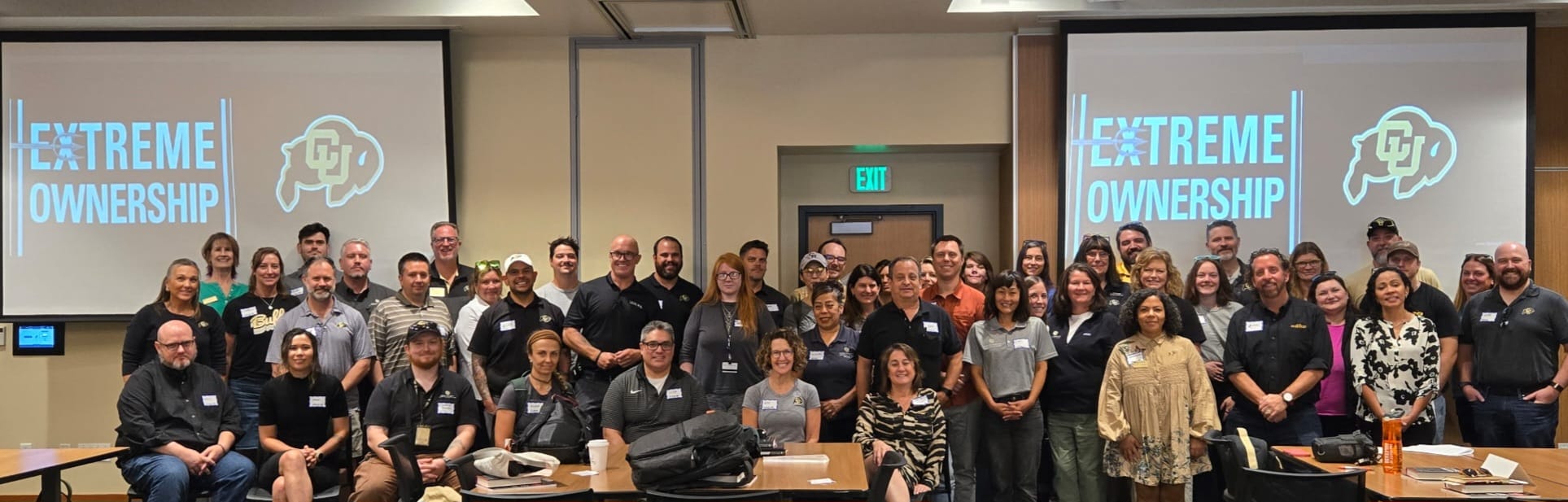
The I&R leadership group originally adopted Extreme Ownership as a way to help employees build practical leadership skills that could be applied immediately in their day-to-day work. Through a 12-week cohort model, participants explore leadership concepts, discuss real workplace situations, and learn alongside colleagues. Participants consistently report increased confidence, stronger communication skills, and a greater sense of accountability, while supervisors have seen improvements in collaboration, problem-solving, and team effectiveness.
The Numbers Tell the Story
Since launching the Extreme Ownership (EO) and Dichotomy of Leadership cohorts, more than 125 CU Boulder staff members, including some outside of I&R, have participated in the training. On a five-point scale survey from Fall 2025, participants rated the program highly, including:
- 4.65 for applying EO principles at work
- 4.52 for applying them personally
- 4.54 for the 12-week cohort model
- 4.46 for confidence using the principles
But perhaps the most telling data point is the evidence showing how it is transforming individuals’ futures. Several program graduates have gone on to take on new leadership responsibilities, including promotions and expanded roles.
What Changed on Campus
“These numbers reflect what we’re seeing every day among program participants and their teams,” said Kelsey Draper, Program Director & Workforce Manager for Business, Finance & Infrastructure at CU Boulder. “Extreme Ownership is no longer just a training program within I&R. It has become a cornerstone of how we develop leaders and build culture in our broader BFI organization.”
Supervisors often cite Extreme Ownership for changes in the day-to-day. Staff members are delegating more effectively. They’re embracing Decentralized Command, one of Echelon Front’s core leadership principles. Instead of bottlenecking decisions, they’re empowering their teams to lead and solve problems. Leaders now explain the “why” behind assignments rather than issuing orders.
Supervisors also report better communication, stronger collaboration, and fewer conflicts. People are pitching more innovative ideas and pushing these solutions forward. And they’re earning campus-wide recognition for it. At the center of this growth is a mindset shift toward Extreme Ownership. People have shifted from defensiveness toward self-accountability.
A Continued Partnership
Draper credits much of the program’s traction to how Echelon Front delivers the material. Rather than abstract theory, the leadership training is anchored in deeply human coaching that makes Extreme Ownership accessible and practical for people at every level of the organization.
“Our people trust the process, they trust the principles, and they trust the guidance they receive,” Draper said. “That trust is what allows the material to take root and create real behavior change among participants across multiple areas of campus.”
The impact has shaped how BFI develops leaders and builds culture, with ripple effects visible through departments, teams, and individuals.
As the 2026 cohort begins, the program continues to build connections among participants from across campus, building leadership skills, strengthening collaboration, and preparing the next generation of leaders.
Looking to bring Echelon Front’s Implementation Program to train your own team? See if this program is right for your organization – talk to our team today.